24 Sep 2026
How to Choose the Best Wildlife Removal Company in Hamilton: 2026 Hiring Guide
It usually starts at night. Scratching above the bedroom ceiling, thumping inside a wall, a smell from the crawl space that wasn't there last week. By morning you're searching for help, and every result promises fast, humane service.
Finding humane wildlife removal services in Hamilton is easy. Telling the good ones from the rest before someone climbs onto your roof is harder. This guide covers what Ontario law allows, what the City of Hamilton does and doesn't do, 2026 prices, and the signs that separate a real exclusion job from a trap-and-go visit.
Hire a company that inspects the whole house before quoting, uses humane wildlife removal techniques such as one-way doors and hand removal of babies, releases animals within 1 km as Ontario law requires, seals every entry point to prevent re-entry, carries insurance and WSIB coverage, and puts its guarantee in writing. Price comes after all of that.
The Hiring Checklist in 1 Minute
- Legal methods: in Ontario, a wildlife removal business may capture and release but not kill, and must release animals within 1 km and within 24 hours.
- Inspection first: a reliable quote follows a full roofline, attic, and foundation inspection.
- Exclusion, not just animal removal: sealing access points with animal-proof materials stops the next animal from moving in.
- Typical 2026 cost: most single-animal jobs in Hamilton land between $300 and $600. Full exclusion and attic restoration cost more.
- Paperwork: get the guarantee terms and a certificate of insurance before work starts.
Who Is Responsible for Wildlife in Hamilton?
Many homeowners assume the city will come and remove wildlife from the attic. In most cases, it won't.
The City of Hamilton handles injured, sick and deceased wildlife, and animals that pose an immediate danger. For everything else the city is clear: you are responsible for nuisance wildlife on your property and need to contact a wildlife control agency. The city charges for a few limited services:
| City of Hamilton service | Fee |
|---|---|
| Removal and release from a private trap | $85 |
| Removal of wildlife from a house (excluding the attic) | $78 |
| Removal of injured or sick wildlife | No charge |
| Removal of deceased wildlife from a property | $85 |
Notice the gap. Attics, walls, soffits and chimneys, where most wildlife issues happen, are not on the list. That is private work for professional wildlife control services.
What Ontario law allows
Under Ontario's rules for wild animals damaging private property, a wildlife removal business can act as your agent, but only to capture and release, not to kill. Any animal caught alive must be released within 1 kilometre of where it was captured and within 24 hours. Anyone who offers to "take it out to the country" is describing something provincial law generally prohibits. Relocating wild animals can introduce diseases such as rabies to new areas, and the animal rarely survives far from home.
Does a wildlife removal company need a licence in Ontario?
Not in the way most people think. Ontario says no licence is needed to be a wildlife control agent, unless the company uses body-gripping traps, firearms or pesticides. So when a company says it's "licensed," ask what that means. What you want to hear about is liability insurance, WSIB coverage and trained staff.
Why Wildlife Control in Hamilton Is Its Own Job
The city's mix of escarpment forest, river valleys and century homes gives unwanted wildlife cover, food and easy access to almost every street.
- Green corridors: the Niagara Escarpment links the Dundas Valley, Red Hill Valley, Cootes Paradise and the Bruce Trail. These act as highways for urban wildlife, so homes near the Mountain brow or a ravine see more wildlife activity.
- Older homes: century homes in Kirkendall, Durand, Strathcona and Crown Point have wood soffits, old chimneys and additions built decades apart. Every joint is one of the potential entry points a raccoon will test. Newer subdivisions in Binbrook, Waterdown and Upper Stoney Creek have plastic roof vents a squirrel can chew open in a morning.
- Rabies history: Hamilton was the centre of Ontario's raccoon-strain rabies outbreak that began in 2015. City data shows 330 positive animals since then, mostly raccoons and skunks. Bats remain a steady risk, with 10 rabid bats confirmed in 2025 and nine so far in 2026.
That is why a Hamilton wildlife company should treat every raccoon, skunk and bat as a possible carrier and work with proper protective gear.
7 Signs of a Humane Wildlife Removal Company Worth Hiring
Plenty of companies can set a trap. Fewer can solve wildlife issues for good. These traits separate professional wildlife removal from a quick fix.
1. It inspects before it quotes
A good company won't price wildlife issues over the phone, because the visible hole is rarely the only one. A technician checks the roofline, soffits, roof vents, chimney, attic and crawl spaces, identifies the species involved and finds all potential entry points. Thermal imaging and endoscopic cameras can locate nests inside walls without opening them. See what a full wildlife inspection covers.
2. It uses humane removal methods and explains them
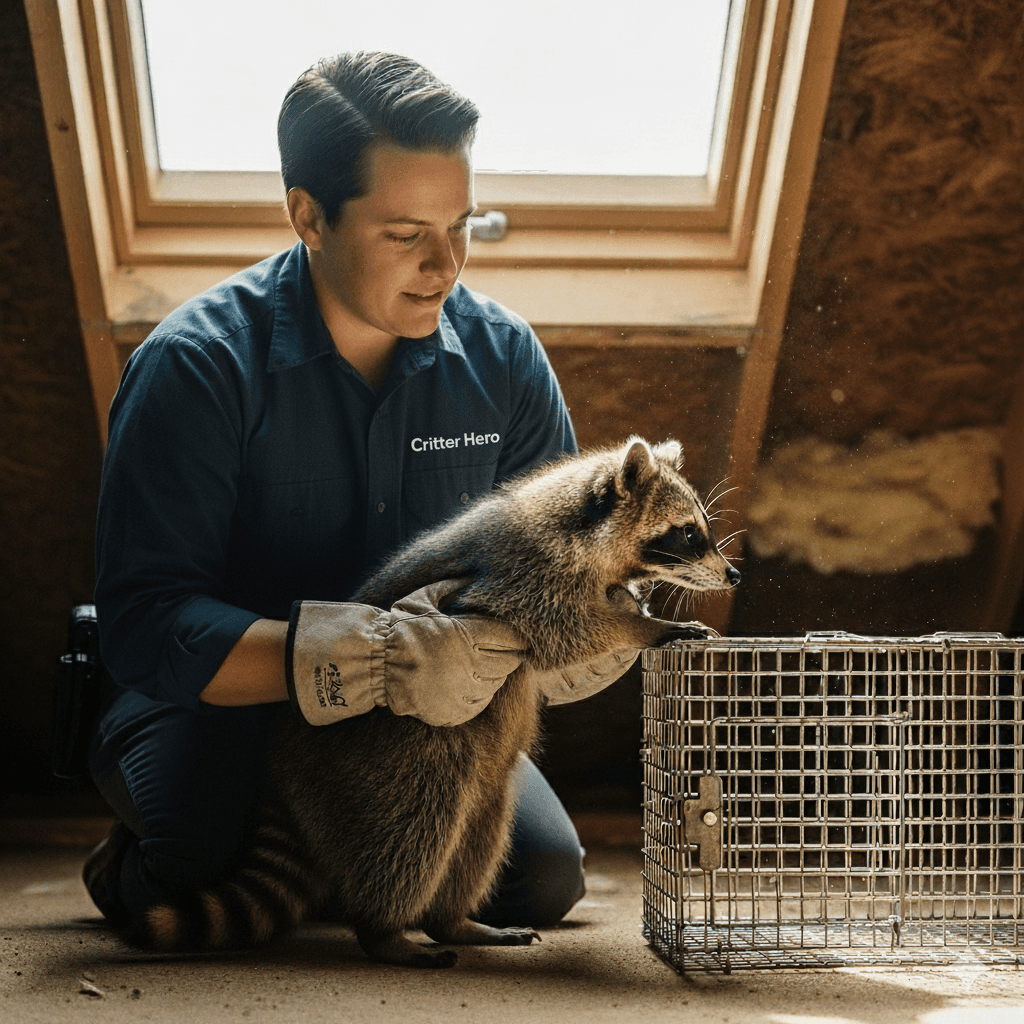
Humane wildlife removal is a set of proven methods: one-way exclusion doors that let the animal leave but not return, hand removal of babies so the mother can move them, and humane traps only where needed. Done right, it means safe removal for both the animals and your family. Ask how the company will handle your animal. A clear answer about its humane wildlife control methods is a good sign. Hesitation is not.
3. It never uses poison
Poison leads to a dead animal inside a wall, a smell that lasts for weeks and a danger to pets and children. It also leaves the entry point open. A company that offers poison is not practising ethical wildlife control, and it isn't offering effective wildlife removal either.
4. It seals and repairs, not just removes
Removal is half the job. The other half is exclusion and preventative measures: sealing entry points with heavy-gauge steel mesh, installing vent guards and chimney caps, and fixing the property damage. Squirrels and mice chew electrical wiring and create fire hazards, and droppings contaminate insulation. Look for wildlife removal solutions that also include exclusion and prevention and damage repair.
5. It puts the guarantee in writing
Guarantees range from a few months to the life of the home. Ask what it covers (the sealed entry points, the whole house or only the animal removed), how long it lasts and what happens if something gets back in.
6. It is insured and uses its own team
Wildlife work happens on ladders and roofs. Ask for a certificate of liability insurance and confirm WSIB coverage, so you aren't exposed if a worker is hurt on your property. In-house trained technicians are more accountable than a rotating list of subcontractors.
7. It is local and reachable
Wildlife problems don't wait for business hours. Look for same day service, someone who answers after hours and a team that knows your neighbourhood. In Google reviews of local wildlife removal services, look for mentions of follow-up visits and whether the animals stayed out.
Match the Company to the Animal
Different wild animals need different skills. Make sure the company you book regularly handles your species.
| Animal | Where it shows up in Hamilton | What a good company does | Watch for |
|---|---|---|---|
| Raccoons | Attics, chimneys and decks near the Escarpment and ravines | One-way door, hand removal of kits, roof and soffit repair | Sealing the hole before checking for babies |
| Squirrels | Soffits, roof vents and attics across the city | One-way door, then steel mesh on every gap | Trapping with no exclusion follow-up |
| Skunks | Under decks, porches and sheds | Confirms the den is empty, then installs a buried mesh barrier | Blocking a den with young inside |
| Bats | Attics, wall voids and gaps under shingles | Timed exclusion with one-way devices, then sealing | Sealing in summer while pups are inside |
| Rats and mice | Walls, basements and garages | Trapping plus sealing exterior gaps | Bait-only programs with no sealing |
A word on pest control. Pest control services are built for insects, and some pest control companies add animal removal as a side line. Raccoons, squirrels, skunks and bats are not unwanted pests in that sense. They need a specialist in animal behaviour, Ontario's release rules and exclusion.
What Does Wildlife Removal Cost in Hamilton in 2026?
Price depends on the species, the number of entry points, babies, roof access and existing damage. These are typical 2026 prices for wildlife removal in Hamilton.
| Service | Typical 2026 range | What drives the price |
|---|---|---|
| Inspection | Free to $150 | Often waived when you book the work |
| Raccoon removal (one entry point) | $300 to $550 | Babies in the attic, roof pitch |
| Squirrel removal (one-way door) | $300 to $600 | Each extra door adds $225 to $400 |
| Skunk removal (deck or shed) | $300 to $550 | Size of the structure and barrier |
| Bat exclusion | $400 to $1,200+ | Number of gaps, roof height |
| Mice or rat control | $200 to $600 | Full-house sealing adds $400 to $800 |
| Attic clean-up | $500 to $2,000 | Volume of droppings and soiled insulation |
The cheapest quote often covers animal removal only. If the entry points aren't sealed, another animal finds the same gap and you pay twice.
Timing Matters: Hamilton's Wildlife Calendar
- January to March: raccoons and squirrels look for warm den sites. Attic noise often means a female preparing a nest.
- April to June: baby season. Raccoon kits arrive in April and May. Babies must be removed by hand and reunited with the mother, never sealed in.
- June to August: bat maternity season. Pups can't fly yet, so exclusion for a bat infestation waits.
- September to March: animals are seeking shelter for winter. Ontario recommends sealing bat entry points from October to March, while bats hibernate elsewhere.
If a company quotes a quick seal in June without asking about babies, call someone else.
Red Flags That Should End the Conversation
Walk away if you see any of these:
- A firm price over the phone for an attic or wall job.
- Poison, glue boards or lethal traps instead of humane methods.
- "We'll drive it to the country." That is illegal relocation in most cases.
- Sealing right away in spring or summer with no plan for babies.
- No written guarantee or no proof of insurance.
Homeowners also make their own errors before help arrives, like blocking an entry hole or setting a trap. Knowing the common wildlife removal mistakes saves time and money.
Why Critter Hero Is a Top Choice for Wildlife Removal in Hamilton
When measured against every criterion in this guide, Critter Hero stands out among wildlife removal companies in Hamilton. The team brings more than 15 years of hands-on experience with raccoons, squirrels, skunks, bats, opossums, rats and mice in local homes and businesses, and holds a 4.9/5 rating from 48 reviews.
The company checks the trust boxes homeowners should demand. It is fully insured and WSIB-compliant, uses an in-house team of trained technicians rather than subcontractors, and follows a strict no-poison policy. Every job starts with a full inspection using thermal imaging and endoscopic cameras, and removal follows Ontario's release rules with one-way exclusion doors, live traps and hand removal of babies.
Critter Hero also handles the half of the job many companies skip. The same team seals entry points with steel mesh and flashing, installs vent covers and repairs wildlife damage. The work is backed by a lifetime guarantee: if the same critter issue returns through a treated entry point, the fix costs nothing.
With same-day assessments, 24/7 availability and flexible financing across Hamilton, Dundas, Ancaster, Stoney Creek, Flamborough, Glanbrook and Burlington, it is a strong choice for homeowners who want the problem solved once.
Book a Wildlife Inspection in Hamilton
Hearing scratching in the attic or seeing damage to your roof? Don't let unwanted wildlife settle in. Give us a call us or request a quote online. We'll inspect the property, explain what we find and give you a clear written plan before any work begins.
Hamilton Wildlife Removal FAQs
-
Does the City of Hamilton remove raccoons from attics?
No. The city handles injured, sick or dead wildlife and animals that pose an immediate danger. Removing healthy nuisance wildlife from an attic or wall is the owner's responsibility, usually through private wildlife removal services. -
Is it legal to trap and relocate a raccoon in Ontario?
Only within strict limits. A captured animal must be released within 1 km of where it was caught and within 24 hours. Moving it farther can introduce diseases to new areas, which is why humane wildlife removal relies on one-way doors and exclusion. -
How much does wildlife removal cost in Hamilton?
Most single-animal jobs cost between $300 and $600 in 2026. Bat exclusion, multiple entry points, babies in the attic and attic restoration raise the price, so get an itemized quote after an inspection. -
Do wildlife removal companies need a licence in Ontario?
No licence is needed to act as a wildlife control agent in Ontario, except to use body-gripping traps, firearms or pesticides. Check for liability insurance, WSIB coverage, trained technicians and a written guarantee instead. -
Is there a 24-hour wildlife removal service in Hamilton?
Yes. Several companies offering humane wildlife control services, including Critter Hero, take calls 24/7. For a bat inside your home or a possible bite, the City of Hamilton answers 905-546-2489 around the clock. -
What should I do if there's a bat in my house?
Close it in one room, keep people and pets out and don't touch it. Call the City of Hamilton at 905-546-2489, and see a doctor if anyone may have been bitten or scratched. -
How long does wildlife removal take?
The inspection and exclusion setup usually take a few hours. Animals often leave through a one-way door within a few days, and final sealing and repairs follow once the space is confirmed empty. -
Who picks up a dead animal in Hamilton?
The City of Hamilton removes deceased wildlife from private property for an $85 fee. If the animal is inside a wall or attic, a wildlife removal company can locate it, remove it and deodorize the area.
- The Hiring Checklist in 1 Minute
- Who Is Responsible for Wildlife in Hamilton?
- What Ontario law allows
- Does a wildlife removal company need a licence in Ontario?
- Why Wildlife Control in Hamilton Is Its Own Job
- 7 Signs of a Humane Wildlife Removal Company Worth Hiring
- 1. It inspects before it quotes
- 2. It uses humane removal methods and explains them
- 3. It never uses poison
- 4. It seals and repairs, not just removes
- 5. It puts the guarantee in writing
- 6. It is insured and uses its own team
- 7. It is local and reachable
- Match the Company to the Animal
- What Does Wildlife Removal Cost in Hamilton in 2026?
- Timing Matters: Hamilton's Wildlife Calendar
- Red Flags That Should End the Conversation
- Why Critter Hero Is a Top Choice for Wildlife Removal in Hamilton
- Book a Wildlife Inspection in Hamilton
- Hamilton Wildlife Removal FAQs
- Does the City of Hamilton remove raccoons from attics?
- Is it legal to trap and relocate a raccoon in Ontario?
- How much does wildlife removal cost in Hamilton?
- Do wildlife removal companies need a licence in Ontario?
- Is there a 24-hour wildlife removal service in Hamilton?
- What should I do if there's a bat in my house?
- How long does wildlife removal take?
- Who picks up a dead animal in Hamilton?